

Solving the right problem
And why it's hard to do in disruptive times

I still remember when a direct report said to me, “You can’t give me a new job with no information.”
I was startled by her words at first because they weren’t true: I had shared resources and initial guidance with her, to orient her to her new scope.
We had both been thrown into new roles as part of yet-another-reorg.
Even though I received next-to-no information about the change, I saw it as my responsibility to create clarity for my team. I gathered the minimal detail I had, was resourceful in filling in gaps in information, and used my better judgment to offer next steps.
This person resisted, and pinned her resistance on a lack of information. But the real issue was that she had never been in an organization that turned over so often, and without notice. She was in deeply unfamiliar territory, felt out of control, and was trying to protect herself from the discomfort of uncertainty and change.
This interaction was an important leadership moment for me because I had to coach her in flexibility and judgment in a direct way that I never had to in the past.
If I had taken her comment at face value — that she didn’t have enough info, and I needed to give her more info — I would not have been solving the right problem. In fact, I would have been trying to assuage her fears rather than helping her to level up. We all would have lost an opportunity to move together and grow with change rather than against it.
In disruptive times, it’s easy to abandon our best judgment and operate from fear or anxiety.
Our self-protective tendencies come out when there’s uncertainty. We’re afraid to rock the boat even more. We find ourselves in defensive default modes that show up as:
Suppressing our beliefs - we don’t challenge perspectives even when we don’t agree with them. We opt for compliance rather than risking debate.
Avoiding reality - we create distance between ourselves and the disruption. Surely if we ignore it, or dismiss it, it will go away.
Creating strict control mechanisms - we refuse to take action without perfect information. We install structures to suppress new opinions.
We may not realize how much energy we pour into trying to protect ourselves from change, rather than discerning where to direct our energy for the well-being of the organization, its mission, and its people.1
So how do we get ourselves out of default response modes, so we can truly and precisely discern which topics or tensions need our attention most? How do we know the core tension is not, for example, a lack of information but a resistance to change?
It takes strong judgment that we can only build from seeking understanding.
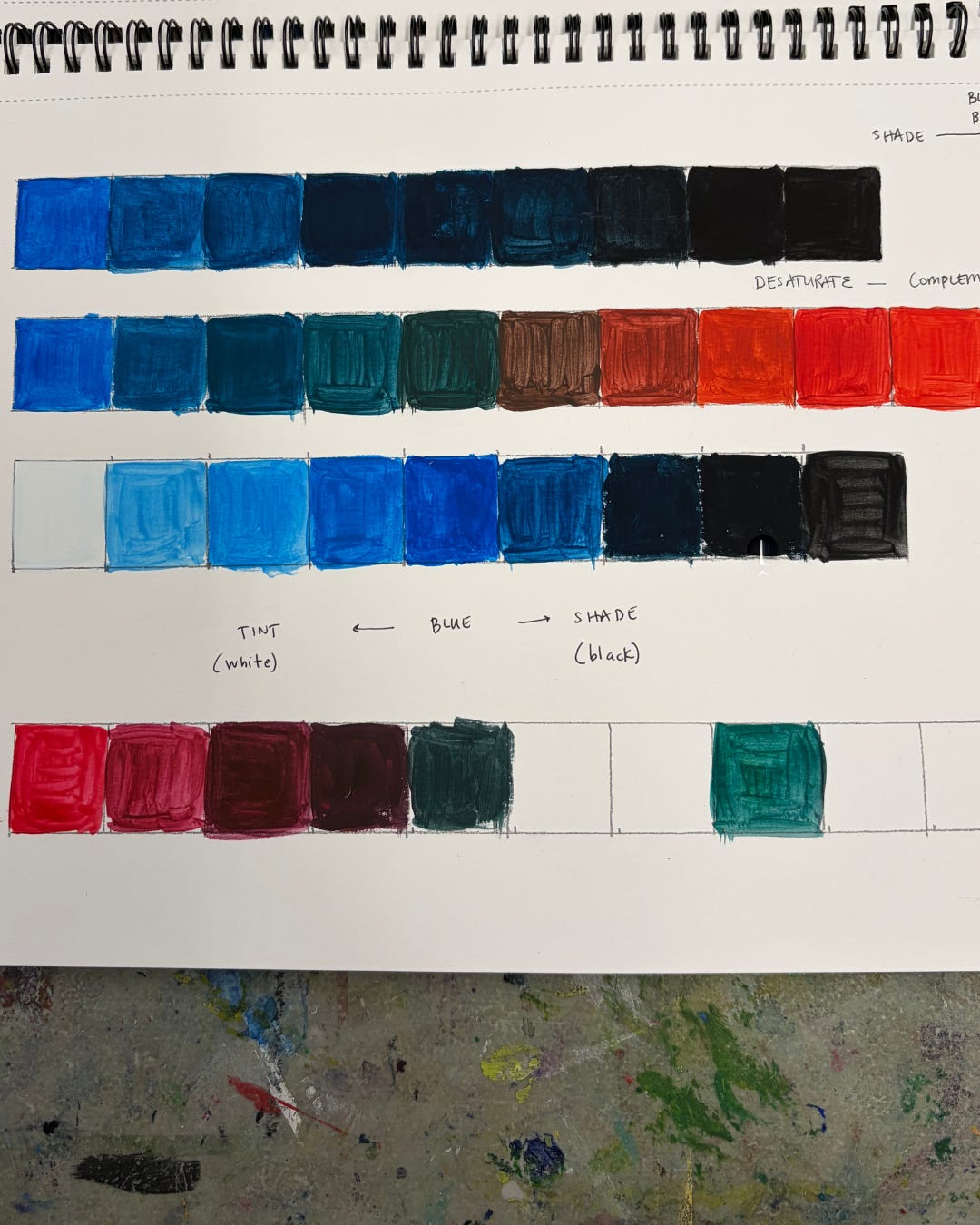
Image: My work-in-progress from a color theory workshop I took last weekend. We went through a series of exercises in what you need to tweak to deliver a certain output.
To build strong judgment, we need to seek understanding of the multiple dimensions that influence our experiences - and focus on truth, even when it’s not in our favor.
Consider:
Personal context - the inner world of your individual beliefs, tendencies, and aspirations.
Micro context - the people and dynamics of the external environment you interact with directly in your day-to-day.
Macro context - social, political, technological, & environmental impacts you could influence but cannot control.
Distinguishing between each of these dimensions, and assessing their interplay, allows us to step outside of the limits of our own experience and parse out: what’s the core topic or tension I need to resolve? What’s at the crux of these dynamics? Where might my own self-protective tendencies be getting in the way?
When I talk about pivotal leadership, I describe it as leadership centered on truth. Solving for the right topic or tension is about being willing to seek out truth, even when it’s not in our favor.
If you’d like to explore this topic further within your specific context, feel free to reach out by replying to this email, or emailing info at coachingwithfarah.com.
My perspective is based on coaching directors to CEOs for more than six years. My framing is influenced by The Leadership Circle Profile, an assessment tool that I’m certified in.