

Being messy
Let's embrace the awkward parts of growth

My first formal exposure to coaching was when my boss got me a coach in 2019.
I wanted to work on being less helpful as my team grew. (You read that right.) While my direct reports gave me high manager ratings, I felt like I was too close to their work. Too readily available to help them problem-solve, train them myself where they had skills gaps, and do some of their work if we had resource limitations.
With this degree of attentiveness, I couldn’t focus on strategic planning, innovate, or expand my leadership capabilities. I was also holding my team back from learning to problem-solve, be resourceful, and prioritize on their own.
I needed to change, but I was having a hard time shifting from being “too helpful” to “strategically helpful”. My people-pleaser was at play, afraid to pull back at the risk of being seen as less caring — even though you could argue that pulling back was a way to show care.
This is one of the hardest parts of behavior change: you know what needs to change, yet you hesitate to disrupt the familiar status quo out of fear of perceived consequences. So you opt to stay stuck.
We talk about creating workplace cultures where it’s ok to fail, but I argue that we need cultures where it’s ok to be clunky. Like when you start wearing new sneakers — like the Hokas I just got after wearing New Balance for years: they may be supportive, but you need time to break them in. If your gait is off, you haven’t failed.
We need self-compassion and environments where we can be clunky because behavior change requires moving through a phase that can be deeply uncomfortable.
Perhaps you want to start:
Saying “no” more, when you almost always say “yes”
Letting others speak first, rather than leading with your POV
Considering your role in a situation, rather than starting with blame
You may feel:
Self-conscious that others notice you’re acting differently
Grief saying goodbye to a characteristic that’s tied to your identity
Tense because you’re not sure if the change will ever feel natural
Here’s the thing. Clunkiness is where it’s at. When we’re growing, we’re in the process of crossing a bridge from where we are to our next phase of evolution.
Your first “no” might sound abrupt after all your seamless “yesses”, or your initial silence in a meeting may create an awkward pause since you’re usually on your soap box. You might even over-explain yourself as you learn to take accountability.
If every step forward is smooth, you’re not building new muscle. And you need new muscles for new phases.
So imagine what your clunky bridge looks like. What’s it made of? What runs below it? How long is it?
Put your attention on your desired outcomes: stronger performance, improved relationships, greater authenticity and ease. The other side of the bridge.
You need new muscle to be able to respond accordingly to meet the particular need of any given moment. Your role-modeling will inspire others to cross their bridges, too.
Which bridge do you want to start crossing?
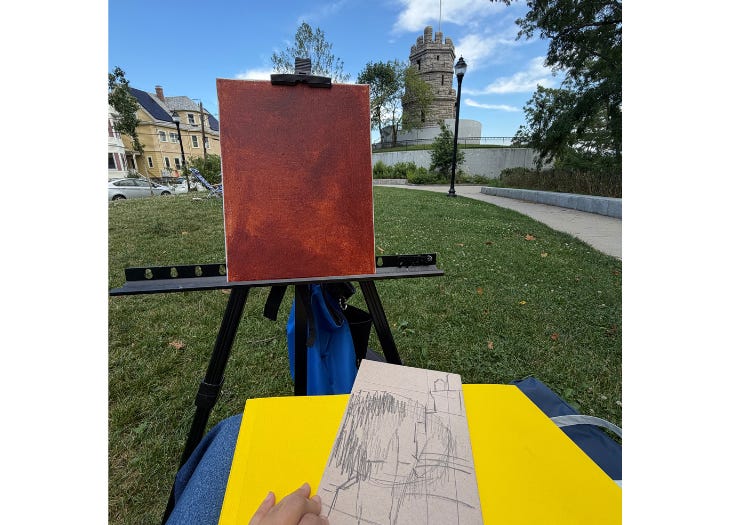
Image: I’ve been thinking about painting “plein air” for a while to get out of the comfort zone of studio painting, and to build new muscle. I knew I had to stop thinking about it and just do it. So, in June, I did.
Behavior change in organizations
We can apply this concept of “bridge-crossing” to structural and systemic change, too. Both inform behavior, and are all interconnected. If you’re an HR / People leader curious about how structural, systemic, and personal behavior change intersect, and want to talk through how to drive specific changes in your organization, hit reply and let’s chat.